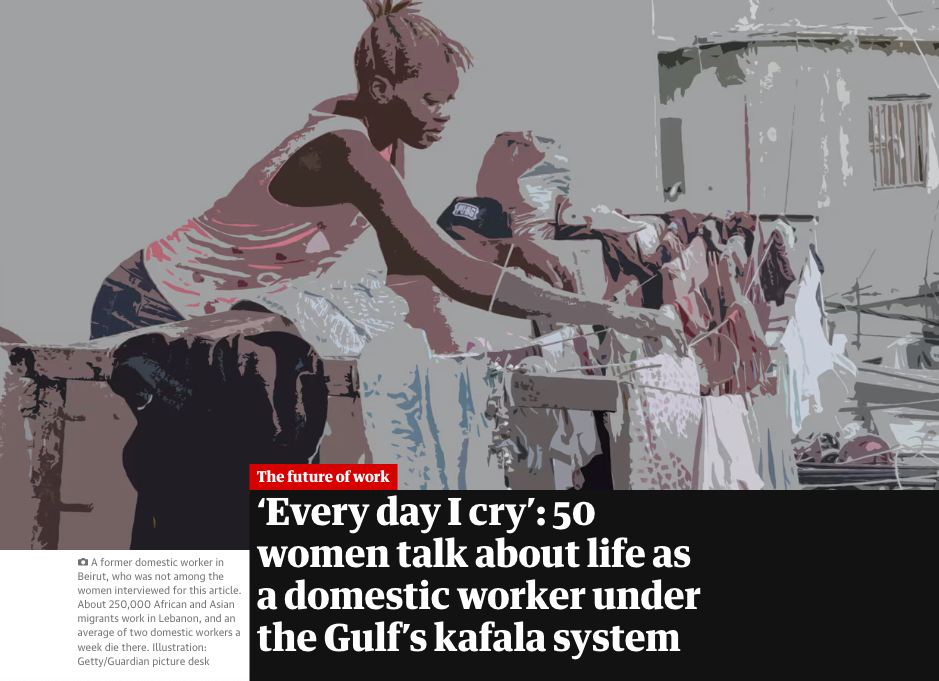
Denounced as giving a ‘veneer of legality to slaveholding’ and despite claims of reform, kafala laws persist, allowing bosses to abuse women, who vanish from society. This is their testimony, gathered over two years in a Guardian investigation
by Katie McQue
Condemned as dangerous and abusive, the kafala labour system not only disregards migrant workers’ rights but depends on exploitation. But 10 years after Qatar was advised by the UN to abolish kafala (“sponsorship”) entirely and replace it with a regulated labour network, the system is thriving across Lebanon, Jordan and the Gulf states – with the region’s most vulnerable migrants hidden behind closed doors.
Over two years, the Guardian spoke to 50 women who are or were domestic workers in the United Arab Emirates, Saudi Arabia, Kuwait, Oman, Qatar or Jordan. Their testimony reveals a section of society operating under appalling conditions facilitated by the state’s employment apparatus.
Female domestic workers, generally excluded from labour protection laws by working in private homes, are heavily dependent on their employers.
Even in states where kafala laws have been amended or reformed, as in Qatar after the 2014 UN report, little has changed and women report conditions that experts say amount to forced labour.
All of the women interviewed worked seven day weeks and had passports confiscated by their employer. Many reported being subjected to violence and sexual abuse. Most had to pay recruitment fees to get their jobs.
These are indicators of human trafficking – defined by the UN as the exploitation of people through force, coercion, threat and deception.
Women spoke of being dehumanised and treated like “animals”. Perlah*, 33, from the Philippines, worked in Jordan for two years, for a family of six in a flat in Amman until 2022. She was given one meal a day of bread and instant noodles, and had no bed.
“I slept on the outside balcony of the apartment,” she says. “It was too cold. The neighbours could see me sleep.”
Beatrice* was 21 when a recruiter – a man from her community in Liberia – told her she had been awarded a scholarship to study in Oman. When she arrived in 2021, she was put to work. “The job is tough. You clean, wash the car, wash clothes. We don’t have any vacation.
“They beat you; they starve you,” she says. “We are dying – we need help.”
Read entire story here: https://www.theguardian.com/global-development/2024/apr/25/kafala-labour-system-gulf-women-talk-about-life-as-a-domestic-worker-in-the-gulf

 Katie McQue